Network Operations
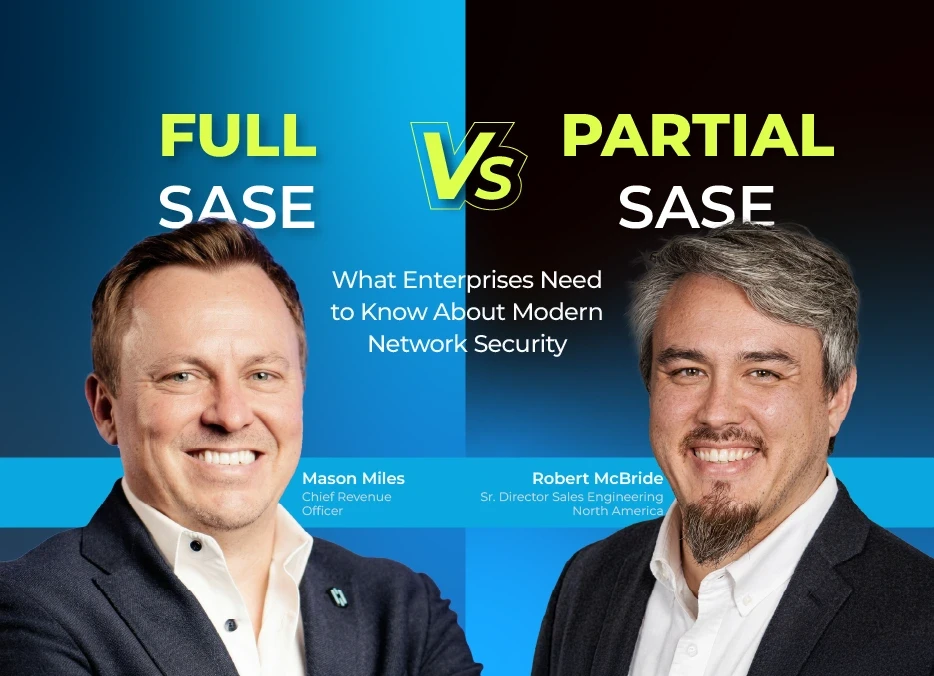
Full SASE vs Partial SASE: What Enterprises Need to Know About Modern Network Security
Secure Access Service Edge (SASE) doesn’t automatically eliminate complexity. But for enterprises stuck managing disconnected security and network tools, it offers a smarter model to simplify and unify both.
A best-of-breed approach to enterprise network security has many adherences, but it comes with an important caveat. Any best-of-breed solution must have strong integration capabilities, which is where complexity begins to surface. As organizations layer multiple tools and providers into their environments, visibility becomes fragmented and operations become more difficult to manage.
SASE is designed to address this challenge by moving networking and security closer to users, devices, and applications through cloud and edge technologies. However, many enterprises today are still operating in a partial SASE model. Understanding how to move toward a fully unified SASE architecture is critical for improving both security and operational efficiency.
What Is SASE and How Does It Work?
SASE, or Secure Access Service Edge, is a unified architecture that converges networking and security into a single, cloud-delivered platform. It applies Zero Trust Network Access (ZTNA) principles across the entire edge, supporting both SaaS applications and private enterprise applications within a consistent security framework.
This approach allows organizations to manage connectivity, access, and security as part of the same system. Instead of relying on traditional network boundaries, SASE enforces policies based on identity, application, and user privilege. This creates a more controlled and consistent environment across all users and locations.
Modern SASE solutions are built around this concept of unification, enabling organizations to simplify operations while maintaining visibility and control across the network.
What Network and Bandwidth Strategies Make SASE Successful at Scale?
The network remains the foundation of any SASE deployment, especially at scale. Enterprises today rely on multiple connections per location, often including primary, secondary, and tertiary options such as 5G or low-earth orbit satellite. While this provides redundancy, it is often implemented in a fragmented way across multiple providers.
A successful SASE deployment focuses on resiliency and diversity. Each connection should differ in delivery method, last mile, and infrastructure, eliminating single points of failure and improving reliability.
This level of diversity allows SD-WAN to dynamically route traffic based on performance and availability. It also enables organizations to move away from reliance on a single provider and instead optimize connectivity across a broader ecosystem.
At the same time, bandwidth must be aligned to the needs of each location. A branch office, data center, and large campus all have different requirements. When designed correctly, organizations benefit from improved performance, stronger resiliency, and more efficient cost management.
Full SASE vs Partial SASE: What Are the Real-World Trade-Offs?
Partial SASE refers to environments where SASE components exist but are not fully integrated. Organizations may deploy SD-WAN, remote access, and cloud security tools from different vendors, but these systems operate independently and do not share intelligence.
This creates fragmentation, where there may be some level of control, but gaps remain, and those gaps introduce risk.
Over time, this leads to increased complexity and technical debt. Organizations must manage multiple tools, maintain separate policies, and reconcile data across systems. It also becomes more difficult to maintain continuity in understanding user activity.
A full SASE architecture addresses this by bringing these components together into a single platform. It provides consistent identity-based policies, shared visibility, and continuity of intelligence across the environment.
The trade-off is clear. Partial SASE increases complexity. Full SASE simplifies operations and enables a more consistent security posture.
How Do Log Analysis and SIEM Integration Help SASE Platforms Make More Intelligent Decisions?
SASE is evolving beyond infrastructure and becoming more intelligent and actionable. A key driver of this is visibility. When log analysis is integrated into a Security Information and Event Management (SIEM), organizations can correlate network performance and security telemetry in real time.
This includes user behavior, application risk, anomaly detection, and performance metrics, all within a single, centralized view.
Platforms that provide unified monitoring and alerts allow teams to operate from a single pane of glass instead of multiple disconnected tools, improving both detection and response.
In more advanced environments, an AI-native IT operations platform can correlate signals across systems and automate parts of the response process, reducing the time from detection to resolution.
At a fundamental level, visibility determines effectiveness. If organizations cannot see what is happening, they cannot act. A unified SASE model provides the level of visibility needed to make informed decisions around traffic prioritization, bandwidth usage, and security posture.
What Drives Enterprises to Move from Partial or Legacy Approaches to Full SASE?
The shift toward full SASE began as organizations adapted to remote and hybrid work. Users moved outside the traditional network perimeter, exposing limitations in legacy VPN-based access models. This created a need for stronger identity-based controls and more precise access management.
As cloud and SaaS adoption increased, organizations also recognized gaps in visibility and control across applications. Managing access in these environments required capabilities such as Cloud Access Security Broker (CASB) and data loss prevention, which are core components of SASE.
Over time, the challenge became operational. Managing multiple tools and vendors introduced complexity that was difficult to scale. Organizations began to look for a more unified approach with a single platform, consistent policies, and shared visibility.
In some cases, a security incident accelerates this shift. In others, it is simply the realization that the current model is too complex.
Most organizations approach this transition as a roadmap. Structured network strategy and design approaches help align current infrastructure with a future unified architecture.
Once an Enterprise Has Committed to Full SASE, What Challenges Remain in Day-to-Day Operations?
Even after deployment, operational challenges can persist. Many enterprises continue to manage networking, security, and monitoring across separate teams and systems. This creates inefficiencies when troubleshooting issues.
When an issue occurs, it may not be immediately clear whether it is related to connectivity, policy, or security. This leads to delays and requires coordination across multiple teams.
Operational fragmentation becomes the primary challenge.
A unified SASE model addresses this by bringing together bandwidth, security telemetry, SIEM data, and visibility into a single environment. This enables faster root cause analysis and more responsive operations, supported by continuous monitoring and real-time insights.
Organizations are also placing greater emphasis on responsiveness, faster change management, and the ability to adapt to evolving demands.
How Is AI Shaping the Future of SASE?
AI is becoming a critical component of modern SASE environments. From a security perspective, organizations are focused on how AI is used and how sensitive data is protected. As AI adoption increases, so do concerns around intellectual property and data governance.
This is driving new use cases, including applying Zero Trust principles to AI interactions. Capabilities such as generative AI controls and data loss prevention help ensure that sensitive information is not exposed.
AI is also transforming operations. It enables organizations to analyze patterns, detect anomalies, and predict potential issues, which supports more proactive decision-making and reduces manual effort.
In more advanced environments, AI is embedded into workflows, helping identify issues, correlate signals, and initiate actions. This improves response times and operational efficiency.
As these capabilities evolve, SASE is becoming not just unified, but intelligent.
Conclusion
SASE is not just a technology shift. It is an operational shift.
The core value of SASE lies in unification. By bringing together networking, security, and access into a single platform, organizations can connect users, protect them, and simplify how their environments operate.
Many enterprises today are not limited by a lack of tools, but by fragmentation. Disconnected systems create complexity and slow down response.
A unified SASE approach aligns technology, visibility, and operations into a single model. It enables faster response, stronger security, and more efficient management.
As enterprise environments continue to evolve, simplicity becomes a competitive advantage.